
A recent report by Morgan Stanley takes a deep dive into sustainable funds as a whole and reports on their performance throughout 2025.
The Morgan Stanley Institute for Sustainable Investing, established in 2013, publishes a ‘Sustainable Reality’ series to assess sustainable funds’ versus traditional funds’ historical performance. Their most recent report on sustainable fund returns in 2025 looked at sustainable fund performance from January 1, 2025 through December 31, 2025 and found that:
- Sustainable Funds’s Total Assets Under Management (AUM) Reached a New Record High of $4.13 Trillion
- Outflows from Sustainable Funds, Compared to Traditional Fund Inflows
- Sustainable Returns Slightly Below Traditional Peers in 2H25, Influenced by Geographic Exposure
Overall Methodology
This report focused on closed-end fund, exchange-traded fund, and open-end fund performance for approximately 110,000 funds globally from January 1, 2025 through December 31, 2025 using Morningstar data. Morningstar classifies sustainable funds as funds that specifically claim a focus on “sustainability, impact investing, or environmental, social or governance (ESG) factors” in regulatory filings; funds employing ESG factors in a non-binding way are not considered.
These sustainable funds were compared against traditional funds, or funds classified as ‘Not Sustainable’ by Morningstar. Total return was calculated using Morningstar’s method of “taking the change in monthly net asset value, reinvesting all income and capital-gains distributions during that month, and dividing by the starting net asset value (NAV).“ For more information on methodology, view page 20 of Morgan Stanley’s report.
1. Sustainable Funds’s Total AUM Reached a New Record High of $4.13 Trillion
Total AUM for these funds continued to expand to $4.13 trillion, demonstrating sustained investor interest in ESG factors. This +16.3% year-over-year growth was a testament to the long-term conviction many investors hold in sustainable investing.
2. Outflows from Sustainable Funds, Compared to Traditional Fund Inflows
Despite record high total AUM, the second half of 2025 saw instances of net outflows from certain sustainable funds, a pattern less common in recent years. Overall for 2025, sustainable funds saw outflows of -1.8% of prior year-end AUM.
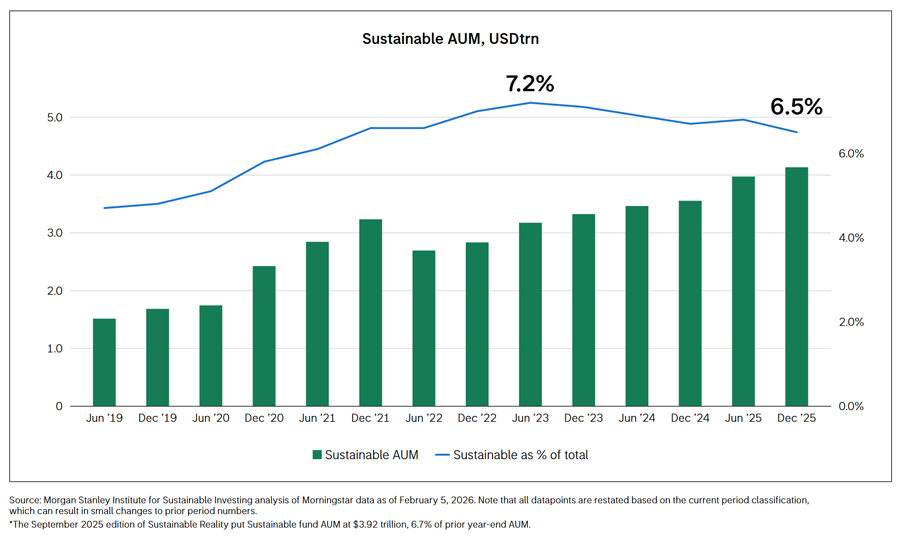
Currently, sustainable funds account for 6.5% of total AUM, a decline from 6.8% recorded in June 2025, and also lower than the peak of 7.2% observed in June 2023. While sustainable fund AUM has continued to increase due to sustainable funds’ returns, in 2025, the proportion of sustainable funds within total AUM saw a noticeable decrease.
Sustainable funds based in Europe experienced the majority of outflows in the second half, totaling $76.4 billion. This was the first occurrence of net outflows for sustainable funds domiciled in Europe from the Sustainable Reality series.
Much of these outflows resulted from asset owners shifting their investments from pooled sustainable funds to customized sustainability-focused mandates. These bespoke mandates are customized investment strategies or corporate compliance frameworks tailored to specific client goals, regulatory requirements, or ethical standards, and aren’t tracked in Morningstar’s fund database, so these reallocations are shown as outflows in the data — even though the money is still invested in sustainability strategies. However, even excluding these instances from the calculation, sustainable funds still saw an outflow, likely due to a shifting political landscape. In contrast, traditional funds maintained net inflows throughout each quarter, concluding FY 2025 with flows at +4.3% compared to the prior year’s year-end AUM.
3. Sustainable Returns Slightly Below Traditional Peers, Influenced by Geographic Exposure
The first half of 2025 saw a strong affirmation of sustainable investing’s outperformance, with sustainable funds earning a median return of 12.5%, notably outperforming traditional funds which delivered 9.2%, marking the strongest period of out-performance for sustainable funds since the Morgan Stanley Institute began tracking data in 2019. However, the latter half presented a more subdued picture.
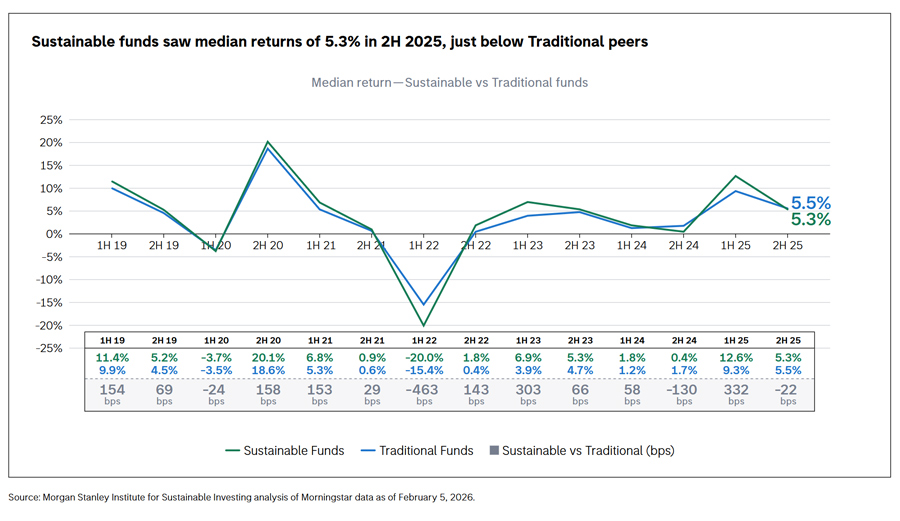
In the latter half of the year, median returns of sustainable funds were 5.3%, just below the 5.5% return of traditional funds. Despite achieving better results in most specific investment areas, the overall performance of sustainable funds was affected by their geographical allocations.
These funds are more concentrated in Global and European markets, which did not perform as strongly during this time. Notably, 70% of sustainable funds include global or European investments, compared to only 40% of traditional funds. This led to sustainable funds slightly under-performing in terms of median returns compared to traditional funds, despite their competitive regional performance and strong performance in the first half of the year.
Conclusion
Morgan Stanley’s recent analysis on sustainable fund performance for the full year of 2025 reported a new record high total AUM, juxtaposed against slight outflows and slightly lower returns versus traditional funds.
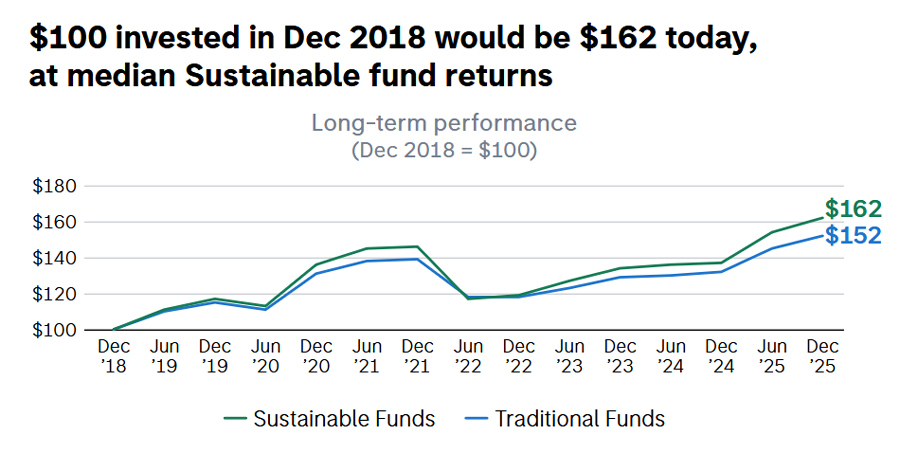
However, long-term sustainability fund performance is still strong. Overall, sustainable fund returns over the last seven years have still outperformed that of traditional funds, even during times of market volatility. 89% of sustainable funds delivered positive returns in the second half of 2025, compared to 84% of traditional funds, showing an investment focused on ESG factors can pay off.
Read the full Morgan Stanley Sustainable Reality report here, and contact our EGÉA SRI team to learn more about our tailored sustainable fund offerings.
This information is subject to change at any time, based on market and other conditions and should not be construed as a recommendation of any specific security or investment plan. Past performance does not guarantee future results. All investments involve the risk of potential investment losses, and no strategy can assure a profit. There is no guarantee that a company with a strong ESG score or one that focuses on sustainable investing will outperform a company with a lower score or without that focus in any given market environment.