
The designation of renewable energy as the “2025 Breakthrough of the Year” by Science, one of the world’s top academic journals, represents more than a victory for climate research — it marks the definitive arrival of a new industrial era.
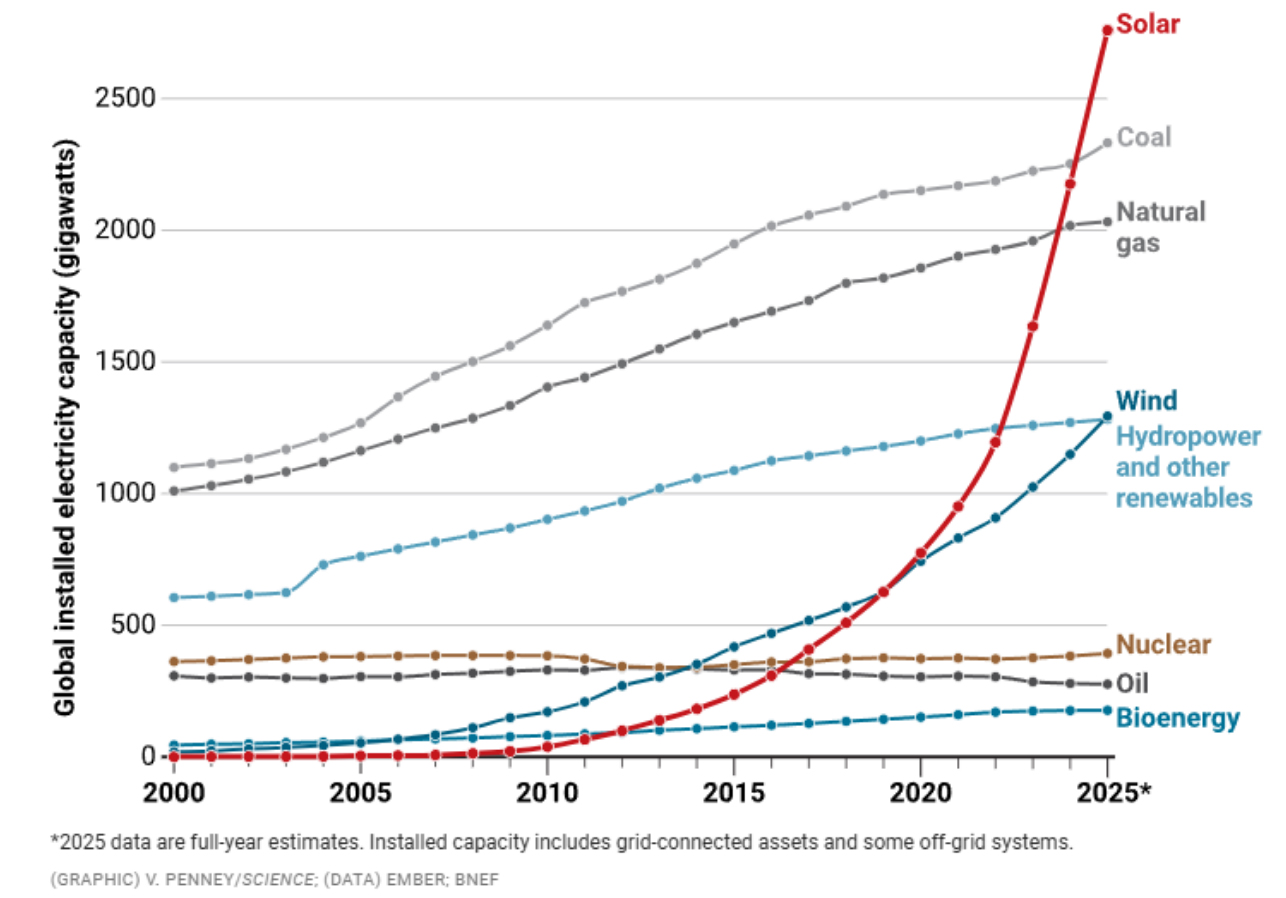
The migration towards renewables is driven by data. In 2025, renewable sources together generated more electricity than coal. Clean energy is now delivering consistent returns, independent of the volatility inherent in fossil fuel markets. And investors are taking note, reclassifying wind and solar portfolios and companies as stable, long-term assets that mirror the maturity of traditional utilities.
2025 Breakthrough of the Year in Energy
In the first half of 2025, the pace of solar and wind energy growth exceeded the rise in global electricity demand, with solar power alone accounting for 83% of this increase. Many countries achieved new records in renewable energy production, while the share of fossil fuels remained largely unchanged, experiencing a minor reduction. Specifically, fossil fuel generation decreased in China and India but saw an uptick in the EU and the US.
Although this comes against a backdrop of many countries and companies failing to meet their 2025 climate commitments, progress has been made nonetheless. As electricity’s role in overall energy consumption grows, the expansion of solar and wind energy has allowed renewables to surpass coal in the global energy mix, helping to stabilize CO2 emissions from the power sector.
Better Technology for a Better Future
In 2025, the focus has expanded beyond simple wattage output to encompass grid stability, storage density, and supply chain security.
Innovation in solar cells has accelerated, with hybrid architectures — such as perovskite-silicon tandems — shattering previous efficiency ceilings. Floating solar technology offers a spatial solution to the land-use constraint. By mounting solar panels on reservoirs and hydroelectric ponds in addition to rooftops, developers reduce water evaporation and improve the operational efficiency of the solar cells through the cooling effects of the water. This dual-use strategy provides a strategic hedge against land-access hurdles in dense markets, particularly across Europe and parts of Asia.
Technological progress in wind power includes the deployment of massive, deep-water offshore turbines allows for constant, high-capacity factors that were previously unreachable. As these units grow in scale, their capacity for high-yield power generation makes them a fundamental component of the baseload. Material and design advances help make wind more feasible for more and more locations throughout the world.
Breakthroughs in battery capacity are perhaps the most underrated technology shift. Until recently, sodium-ion technology had mostly been in the pilot and early deployment stages, particularly in China, but this is now changing. Although sodium-ion lags behind lithium-ion in terms of energy density and cycle life, and remains more expensive than lithium-ion in many cases, its lower theoretical cost due to cheaper raw materials, along with safety and supply chain advantages, positions it as a strong contender for stationary storage.

Resiliency of Renewables
Resilience is not just a defensive play; it is the primary engine of value creation. Resilience for renewable energy means the ability of a portfolio to survive energy shocks, whether through diversified storage solutions or localized microgrid deployments.
And this resiliency is increasing throughout the globe. China remains the dominant manufacturer of solar cells and turbines, while Europe leads in policy adoption and grid integration. The U.S., meanwhile, is focusing on onshoring supply chains.
As production of renewables such as wind and solar increased, prices dropped, leading to a surge in demand. This uptick in production aligned to meet the growing demand, further reducing prices and fueling even greater demand. This created a virtuous cycle that transformed renewable technologies into the robust industry we’re seeing as we head into 2026. Consequently, wind and solar have emerged as the most cost-effective energy sources in much of the world.
The science behind renewable energy has matured, but the breakthrough of 2025 is primarily a triumph of integration. Solar, wind, and battery storage are now the pillars of a resilient economic system that offers predictable, long-term returns for investors.
EGÉA SRI keeps our finger on the pulse of new technologies and emerging companies so you don’t have to. Contact us today for a free consultation to discuss how your portfolio can benefit from the clean energy transition.
This information is subject to change at any time, based on market and other conditions and should not be construed as a recommendation of any specific security or investment plan. Past performance does not guarantee future results. All investments involve the risk of potential investment losses, and no strategy can assure a profit. There is no guarantee that a company with a strong ESG score or one that focuses on sustainable investing will outperform a company with a lower score or without that focus in any given market environment.